My first passenger
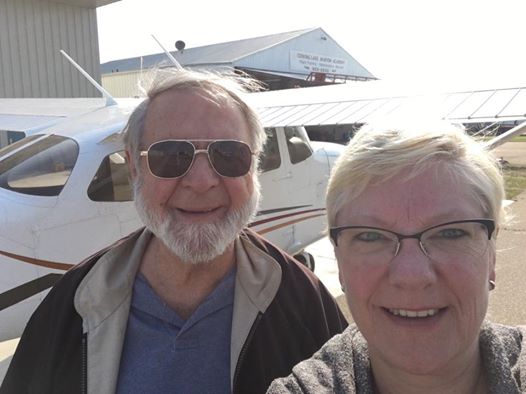
I took my first passenger up today. My dad is a pilot and I spent my whole life flying with him so it was an honour and a thrill for me to take him up on my first flight as a licensed pilot. He wanted to do circuits with me since it's "the biggest bang for my buck." We did six. It's a lovely day today. My circuits were sharp and my landings were good. Glad I could pull it off with him in the plane with me! He barely said a word but he really enjoyed it and I could tell he was proud of me. So cool.
I am a pilot!
I took my flight test two days ago and I passed! I am a licensed private pilot!
That was stressful! Everything you know has to come together in one shot! You don't have to be perfect but you have one chance to demonstrate each skill so you have to get it pretty close the first time. The test begins with a circuit to demonstrate a specialty take-off and landing. I was asked to do a short field take-off and then he let me choose the landing so I opted for the soft field. That went well.
After that, we departed for the cross-country/navigation demonstration. The night before, I had to prepare a flight plan for a trip that we would start on during the test. I was happy with my departure procedure and I was bang on track at the first checkpoint, where I had to calculate my ground speed and ETA. Then we stopped that exercise and headed toward the practice area. The rest of the test included stalls, steeps turns, slow flight, slipping, instrument flying with the hood on so you can't see outside, emergency and precautionary landings, and diversions. My instrument time wasn't ideal because I didn't have the plane trimmed up nicely so I didn't hold my altitude as well as I could have. Everything else was good, I thought, but I didn't know what my marks were. The examiner was kind and fair but I was still pretty intimidated! On the 10 minute flight back to the airport, we chatted about this and that. I did a nice landing and taxied back to the flight school hangar. After I had shut down, he said, "Well, Sarah..." - eternal pause, my heart was pounding - "....Congratulations! That was a nice flight test." I threw my head back and let out a big sigh! What a relief! What a thrill! When I went inside to do the log books, everyone in the office congratulated me and I actually jumped up and down with excitement.
Today I went out to the airport again to get my temporary license signed and to see my instructor, who was not at the airport during my test (he was, in fact, flying up north that day, and heard me on the radio during my flight test). He was very pleased for me and proud of me. He is the most awesome instructor I ever could have had. This was a great day. I did it!

 |
| This is the plane I flew for the test |
After that, we departed for the cross-country/navigation demonstration. The night before, I had to prepare a flight plan for a trip that we would start on during the test. I was happy with my departure procedure and I was bang on track at the first checkpoint, where I had to calculate my ground speed and ETA. Then we stopped that exercise and headed toward the practice area. The rest of the test included stalls, steeps turns, slow flight, slipping, instrument flying with the hood on so you can't see outside, emergency and precautionary landings, and diversions. My instrument time wasn't ideal because I didn't have the plane trimmed up nicely so I didn't hold my altitude as well as I could have. Everything else was good, I thought, but I didn't know what my marks were. The examiner was kind and fair but I was still pretty intimidated! On the 10 minute flight back to the airport, we chatted about this and that. I did a nice landing and taxied back to the flight school hangar. After I had shut down, he said, "Well, Sarah..." - eternal pause, my heart was pounding - "....Congratulations! That was a nice flight test." I threw my head back and let out a big sigh! What a relief! What a thrill! When I went inside to do the log books, everyone in the office congratulated me and I actually jumped up and down with excitement.
Today I went out to the airport again to get my temporary license signed and to see my instructor, who was not at the airport during my test (he was, in fact, flying up north that day, and heard me on the radio during my flight test). He was very pleased for me and proud of me. He is the most awesome instructor I ever could have had. This was a great day. I did it!

"Don't let that plane land!"
June was my last month of training. I spent some time with my instructor, reviewing emergency landings and some of the other maneuvers I will have to demonstrate on my flight test, and I did my last hour of required solo time. I feel good about most skills but I have struggled with landings all along and, for most of this month, was still not quite getting the feel for it. I did a practice flight test with the chief flight instructor just to see if I was ready for the real thing. Other than messing up the steep turn like I never have before, the ride was a good one, except for the landings! I have to do two landings for the flight test, including a specialty landing (special techniques for short runways or grass runways), and I can't blow the whole thing because I mess up the landing!
I have done well over 100 circuits to practice landings and watched many YouTube videos about how to land a plane. My ground school instructor jokingly explained to us that a good landing is when you can walk away from it and a great landing is when you can use the plane again. By that definition, they've all been great but they sure haven't all been pretty and a couple were quite marginal!
I am not patient and I tend to try to overcontrol the flow of life. I can strategize and put a good plan in place to reach my goals but I just do not have patience for the process or the journey. These personal characteristics are exactly why landing the plane was hard for me.
A good landing depends on a good approach. That part of it has never been hard for me. I got the hang of the circuit right away and have almost always been able to set up a nice, stable approach and put myself in position for the landing. But it would all fall apart in those last, critical 15 seconds when the plane is right over the runway, just about to touch down.
In those last few seconds, the landing depends on two things: patience and perspective. As you pass over the numbers at the end of the runway, you have to shift your gaze from close to far, and look way down to the end of the runway, gradually raising the nose of the plane as it nears the ground. This is called the flare. These adjustments require patience. Ironically, the point of the action the pilot takes in these moments is to try to hold the plane off the runway, instead of trying to put it down, so that it can slow down and slide itself in. My ground school instructor told us that if we spoke the words, "Patience, patience, patience" to ourselves while in the flare, then that would allow the time it took for the plane to be ready to stop flying. One instructor I flew with said, "Don't let that plane land!" He taught me that NOT trying to land the plane is what actually makes it land.
I did it wrong so many times during my training. I tried to flare too forcefully and too soon and then push the plane down onto the runway in my eagerness to be there. I kept my eyes on the nose of the plane instead of taking the long view down the runway so I could see the subtle changes in the process and make the adjustments needed to ease it in. My rush to be there led to some hard landings, bouncing back up and down again, because I was not waiting for it to come together and for the timing to be right. You cannot make a plane land. It has to be ready. The pilot's job is to get it ready.
The time it takes to land is not long but it's a period of time where time seems to stand still. A lot of happening in those seconds but it is happening by itself in a way, enabled by a patient, focused, and skilled pilot. The pilot is very much in control of what happens yet must also be willing to wait for the plane's own timing. Some days, the plane seems to float forever, eating up the runway, not touching down. Those situations test a pilot's patience more than ever but it is even more important.
Clearly, this is instructive for life in general. When I finally realized that I have to wait and take a long view, I got it. I stopped trying so hard. It worked. I landed the plane. Five, then ten "greasy" landings. And quite suddenly, my fear of landings dissipated, in much the same as as the airspeed bleeds off during the flare. I have to say that this revelation is still quite new for me. I still worry about landing. I still have to embed this lesson into myself. But I see it differently now. I know now how I need to view this to make it work.
Patience. Trust the time it takes to come together. Take a different perspective. This doesn't mean being passive; you have to stay focused on the goal, be an active part of the process, and make adjustments to ease the transition, but in the end, not pushing so hard will make it work out much better than forcing it.
As I reflect on my landing woes over the last six months, I can see that learning to land a plane has been perhaps one of my greatest life lessons and one of the most dramatic examples of how flying is a metaphor for life.
Seaplane
This weekend, I went to Victoria, BC to visit a friend. I had only booked my flight as far as Vancouver so my timing could be flexible but the day before I left, I decided to take the seaplane from Vancouver to Victoria. There's a seaplane base next to Vancouver International (YVR) and you arrive right into Victoria harbour. It's very convenient and I thought it would be a fun experience.
On the shuttle from YVR to the seaplane, I asked the driver how many seats the plane had. She said it depends on whether you count the one next to the pilot. I asked how you get to be the one who sits next to the pilot, thinking that for sure it involved paying more money. "You just ask the pilot!" she said.
I waited to see the pilot of my flight and then made sure I was first in line to ask him if I could sit up front with him (as it was, nobody else was vying for the right seat). He said yes!

He was really great. He pointed out landmarks, explained the complicated airspace in that area, and told me who he was talking to on the radio throughout the flight.
As we approached Victoria, he remarked how beautiful the view was and said, "It never gets old. Flying is divine." So true.
I took the seaplane back to Vancouver on my trip home, too, and sat in the cockpit with the pilot once again. This was an incredible experience that made quite an impression on me! I can see myself flying a float plane someday....
On the shuttle from YVR to the seaplane, I asked the driver how many seats the plane had. She said it depends on whether you count the one next to the pilot. I asked how you get to be the one who sits next to the pilot, thinking that for sure it involved paying more money. "You just ask the pilot!" she said.
I waited to see the pilot of my flight and then made sure I was first in line to ask him if I could sit up front with him (as it was, nobody else was vying for the right seat). He said yes!

He was really great. He pointed out landmarks, explained the complicated airspace in that area, and told me who he was talking to on the radio throughout the flight.
 |
| Over the gulf islands |
 |
| Over Victoria |
 |
| On approach into Victoria harbour |
The other side
One of the perks of being a pilot is that you can usually find a way to arrange a visit to a control tower. This morning, I was able to have a tour of the new and beautiful tower at the international airport. As I climbed the stairs, I could not believe the amazing panoramic views of the prairies from up there. Absolutely stunning!

One of the controllers spent 40 minutes with me, explaining their systems and the ways they coordinate traffic flows and communications among aircraft, the terminal zone, tower, approach/departure, and ground. It was fascinating to see how this works from the other side and to have this perspective on air traffic.

One of the controllers spent 40 minutes with me, explaining their systems and the ways they coordinate traffic flows and communications among aircraft, the terminal zone, tower, approach/departure, and ground. It was fascinating to see how this works from the other side and to have this perspective on air traffic.
The long cross-country 2.0 - Solo
For my short cross-country flight, I ended up having to wait two months between the time I did it dual (Feb 24) and my chance to do it solo (Apr 29), thanks to bad weather. But this time, for my long cross-country, I only had to wait a week! The weather's been nice lately so I was able to head off alone on Friday, while the experience of last week's dual flight was still fresh.
I reversed the route we did last week so that the navigation was still a challenge and I'd have to approach the destination airports from different angles.
I got clearance into the terminal control zone a few minutes after taking off, this time heading over the very south end of city, just a few miles north of the international airport. The controller asked me to turn from my southwesterly heading to a northerly heading, to make room for some traffic on approach to the international. That little deviation from course didn't concern me since I was still over the city and there were many landmarks to get me back on track.
I was cleared enroute west of the international and by then I was halfway to Drayton Valley, which is 67 NM from my home airport. I passed over a large power plant - easy to spot - and then followed the river in.
I saw the town and airport from a long way off. My landing was fine. I recorded my times, texted my instructor, and taxied back to the threshold for take-off. There was nobody on the ground at the DV airport but there were helicopters in the area and someone passing just across my climbout path so I waited for the traffic to clear and then pushed in the throttle!
Two things make it very easy to navigate the 60 NM flight from Drayton Valley to Whitecourt: A huge lake and a big hill at the end. Chip Lake is halfway so I aimed for it first. The terrain is rolling but still mostly prairie so the big hill stands out as a great landmark. The Whitecourt airport is tucked right behind it.
Whitecourt airport has a Mandatory Frequency, which means that you talk to a radio operator on the ground, who is not an air traffic controller but provides information and helps incoming pilots coordinate their arrivals. I contacted Whitecourt Radio when I was 15 NM out. About the same time, a somewhat pushy and obnoxious pilot, incoming from the south as well but a few miles west of me, contacted the MF. He misunderstood a question the MF operator asked and then was rude to him, as if it were the radio operator's fault. His radio transmissions were a little unclear so when he was asked to repeat himself, he spoke deliberately slowly, like he was talking to someone he thought was stupid. Anyway, we were going to be arriving at nearly the same time so I was focused on being sure I knew where he was in relation to me.
Circuits are flown counter-clockwise (left hand) unless otherwise noted and circuits on Runway 29 at Whitecourt are right-hand. The rude pilot did not know that and was not listening when told that. So I made the approach with a right-hand circuit and he announced that he intended to join left-hand. I was concerned that we were on a collision course on the base leg, the leg of the circuit just before turning final. I announced my position in the RIGHT hand circuit a couple of times to Whitecourt Radio but the other pilot never clued in and didn't announce his location as he approached. I kept my eyes peeled but didn't see him before I turned final. Meanwhile, it was windy there and flying the circuit was like riding a bronco so I was holding on tight while avoiding the traffic! I made it to the runway, greased the landing!, and taxied over to the terminal. Mr. Rude Pilot landed a minute after me.
By this time, I was over two hours into the trip so I needed to stretch and pee. I went into the little terminal and rested on the couch for 10 minutes. I called flight services to amend my flight plan since I had stayed on the ground longer than expected and then hopped in my plane for the last leg.
The leg between Whitecourt and Cooking Lake was the longest of the trip, at 104 NM. I decided not to bother with the overhead departure procedure, which makes it easier to set an accurate heading, because half of the flight home follows a major highway. So I climbed out, lined up with the highway and set my heading then. I checked the map from time to time since the highway weaves a bit, of course, just to be sure I was in line with other landmarks. It was very bumpy but it didn't bother me and I took some time to enjoy the beautiful views. I was feeling pretty relaxed.


As I approached the city, I got clearance to transition across the control zone, and was then cleared to descend into Cooking Lake as I left the city on the east side. My total flight time was 3.6 hours (231 NM). I was exhausted when I landed but definitely thrilled. The flight went very well. It's hard to believe that I just did that when I think back to the out-of-body experience of my first lesson, when I just had to fly straight and level for 2 minutes. A lot of the time, I still feel nervous and so novice but this flight showed me that I have learned a lot and I am becoming a pilot!
I reversed the route we did last week so that the navigation was still a challenge and I'd have to approach the destination airports from different angles.
I got clearance into the terminal control zone a few minutes after taking off, this time heading over the very south end of city, just a few miles north of the international airport. The controller asked me to turn from my southwesterly heading to a northerly heading, to make room for some traffic on approach to the international. That little deviation from course didn't concern me since I was still over the city and there were many landmarks to get me back on track.
 |
| Between city and international airport |
 |
| West of Edmonton, enroute to Drayton Valley |
Two things make it very easy to navigate the 60 NM flight from Drayton Valley to Whitecourt: A huge lake and a big hill at the end. Chip Lake is halfway so I aimed for it first. The terrain is rolling but still mostly prairie so the big hill stands out as a great landmark. The Whitecourt airport is tucked right behind it.
 |
| Chip Lake |
Circuits are flown counter-clockwise (left hand) unless otherwise noted and circuits on Runway 29 at Whitecourt are right-hand. The rude pilot did not know that and was not listening when told that. So I made the approach with a right-hand circuit and he announced that he intended to join left-hand. I was concerned that we were on a collision course on the base leg, the leg of the circuit just before turning final. I announced my position in the RIGHT hand circuit a couple of times to Whitecourt Radio but the other pilot never clued in and didn't announce his location as he approached. I kept my eyes peeled but didn't see him before I turned final. Meanwhile, it was windy there and flying the circuit was like riding a bronco so I was holding on tight while avoiding the traffic! I made it to the runway, greased the landing!, and taxied over to the terminal. Mr. Rude Pilot landed a minute after me.
By this time, I was over two hours into the trip so I needed to stretch and pee. I went into the little terminal and rested on the couch for 10 minutes. I called flight services to amend my flight plan since I had stayed on the ground longer than expected and then hopped in my plane for the last leg.
The leg between Whitecourt and Cooking Lake was the longest of the trip, at 104 NM. I decided not to bother with the overhead departure procedure, which makes it easier to set an accurate heading, because half of the flight home follows a major highway. So I climbed out, lined up with the highway and set my heading then. I checked the map from time to time since the highway weaves a bit, of course, just to be sure I was in line with other landmarks. It was very bumpy but it didn't bother me and I took some time to enjoy the beautiful views. I was feeling pretty relaxed.


As I approached the city, I got clearance to transition across the control zone, and was then cleared to descend into Cooking Lake as I left the city on the east side. My total flight time was 3.6 hours (231 NM). I was exhausted when I landed but definitely thrilled. The flight went very well. It's hard to believe that I just did that when I think back to the out-of-body experience of my first lesson, when I just had to fly straight and level for 2 minutes. A lot of the time, I still feel nervous and so novice but this flight showed me that I have learned a lot and I am becoming a pilot!
Onward and upward: The long cross-country
Today, my instructor and I did the second of the required cross-country flights. This was the long cross-country, which has to be a triangular route of a minimum of 150 nautical miles; this flight was 230 NM. We went west over the city, first to Whitecourt and then to Drayton Valley. I chose the route because it would take us through the Edmonton terminal control zone and give me some experience talking to air traffic control.
It was a gorgeous day and a beautiful route. The prairies are very green right now. Heading west, the terrain becomes a little hillier and eventually the mountains appear in the distance. We took a short break in Whitecourt and then went on to Drayton Valley.
I really like my instructor, which is nice when you spend hours in a tiny cockpit together. We both had fun and enjoyed the day and the flight went without a hitch. I will do this by myself next week. I'm ready.
 |
| East side of Edmonton, just after departing Cooking Lake |
 |
| Over downtown at 4000' above ground |
 |
| Leaving Whitecourt |
 |
| Almost home - Cooking Lake on the horizon |
Subscribe to:
Posts (Atom)